Please click on the following link to see the article here.
China Gives a Cool Boost to Effort to Reduce Global Warming
The U.S. and China affirmed their joint commitment to phasing down HFCs in line with the Kigali Amendment to the Montreal Protocol yesterday, following two days of talks between U.S. Special Presidential Envoy for Climate John Kerry and China Special Envoy for Climate Change Xie Zhenhua. The joint statement, part of a larger package of collaborative approaches to tackling the climate crisis, builds on the news of China’s decision to accept the Kigali Amendment last week.
Lolita Jackson to Receive Honorary MBE
Lolita Jackson, American business executive, to receive Honorary MBE
Honouree recognised for services to US and UK transatlantic relations
(NEW YORK – 18 MAY 2021): On behalf of Her Majesty Queen Elizabeth II, Antony Phillipson, British Consul General in New York and Her Majesty’s Trade Commissioner for North America, is pleased to announce that Ms. Lolita Jackson, former Special Advisor of Climate Policy & Programs, Office of the New York City Mayor, has been recognised by the UK Honours System. Ms. Jackson has been made an honorary Member of the Most Excellent Order of the British Empire (MBE) in recognition for her services to transatlantic business relations and climate diplomacy.
“I congratulate Lolita on her well-deserved honour,” said Mr. Phillipson. “For over a decade, she has championed UK-US relations across a wide variety of sectors. From climate finance to her former role as Chairman of the British American Project, Lolita’s tireless networking has provided the UK Government with invaluable support in the NYC-area and across the US.”
Since 2004, Ms. Jackson has been a firm friend of the British Consulate. As a fellow with the British American Project, she has helped the UK Government vastly expand their network of influencers across the US. She has also significantly enhanced UK-US ties through her leadership of the Royal Society of Arts in the USA; her work on climate resilience at the NYC Mayor’s Office (on which she has also boosted collaboration with the UK and been an advocate for UK climate goals); and her broader cultural links to the UK, and especially Scotland.
“I am thrilled to receive this honor. The very first trip I ever needed a passport for was to the UK over 25 years ago, and I have been engaging ever since with its people, its institutions and its culture through volunteer leadership and musical performance. From Edinburgh, to Cardiff, to Isle of Wight and all points in between – it has been a privilege to help foster relationships and engage deeply in British society.”
Ms. Jackson currently serves as Executive Director of Communications & Sustainable Cities with Sustainable Development Capital, LLP. She has been a fellow at the Royal Society of Arts since 2010, joining the Board of RSA US in 2013 and becoming US Chair in 2016. In this guise, she has hosted events throughout the US for fellows and interested parties, working with Consulates in Boston, Miami and San Francisco and the Embassy in Washington. She has also been a Trustee of the Children’s Aid Society Charity for more than 17 years. She is also a member of The Saint Andrew’s Society of New York.
The UK honours system recognises exceptional achievement and service to the nation, and includes non-British nationals who receive “honorary” awards for their important contribution to British interests. All British honours are awarded on merit, and honorary awards are conferred by HM The Queen on the advice of the Foreign, Commonwealth, and Development Office. Ms. Jackson may forthwith use “MBE” after her name should she wish to do so.
###
For more information, please contact:
Toby Usnik, Head of Communications
Acquisition of a US Commercial District Energy System
SDCL Energy Efficiency Income Trust plc, the first UK-listed investment company of its kind to invest exclusively in the energy efficiency sector, has agreed to acquire a 100% equity interest in a commercial district energy system, RED-Rochester, LLC, (”RED”) from a fund managed by an affiliate of Stonepeak Infrastructure Partners for an equity cash consideration of approximately $177 million.
RED is one of North America’s largest district energy systems with 117 MW of steam turbine generators plus boilers, chillers and other equipment that provide exclusive utility services to commercial and industrial customers within the 1,200 acre Eastman Business Park, located in Rochester, New York. The park’s origins date back to 1891 when Kodak started manufacturing film and paper in four newly constructed buildings and is now host to a diversified base of commercial and industrial businesses including manufacturing, chemicals, pharmaceuticals and food and beverages.
As the exclusive provider of utility services to the park, RED offers 16 on-site services including electricity, steam, chilled water, wastewater, compressed air, nitrogen, lake water treatment, industrial water distribution and high purity water distribution. This “plug-and-play” set of utility services is a key attraction of the park, providing simple integration for new customers and allowing existing customers to expand their operations.
RED has over 100 commercial and industrial customers, typically contracted on a 20-year fixed-term basis with automatic five or ten year renewals, linked to their tenancy on the Eastman Business Park. The contracts provide stable and predictable cash flows with substantial mitigation against volatility in demand. Some two thirds of the value of RED’s offtake contracts are derived from investment grade or equivalent counterparties(1). RED’s cost base is relatively fixed, providing good visibility of cashflows.
Since 2016, RED has delivered 40+ energy efficiency projects across its operations that have resulted in annual savings of over $4 million and carbon savings of over 50%. Additionally, the Investment Manager has identified a further pipeline of potentially accretive energy efficiency initiatives that it believes can deliver additional cost and carbon savings.
The acquisition will be funded from existing cash reserves and RCF facilities, which includes the capital raised by SEEIT in the equity fundraising in February. RED’s existing project debt finance facilities, which are equivalent to c.$83 million, will remain in place. Completion of the acquisition is expected after satisfactory conclusion of customary regulatory conditions and consents.
The investment is expected to achieve SEEIT’s total returns objectives and to further support its progressive dividend policy.
Commenting on the acquisition, Jonathan Maxwell CEO and Founder of Sustainable Development Capital LLP, said:
“SEEIT is acquiring an operational and established district energy system that provides a range of essential and efficient energy services and utilities to a diversified customer base on one of the largest business parks in the United States of America. We expect the project to make positive contributions to SEEIT’s earnings and cash flow. At the same time, the project offers the potential for growth over the medium to long term through the addition of new customers and the implementation of accretive energy efficiency measures.”
Agreement Signed with Chargemaster Limited
The SDCL managed investment company, SEEIT, is pleased to announce that it has signed an agreement with bp pulse, the UK’s largest operator of public electric vehicle charging points.
The agreement represents a significant step forward in the roll out of national EV charging infrastructure, expected to result in the development and construction by The EV Network of a significant number of rapid and ‘ultra-fast’ EV charging locations.
Development and construction is expected to start immediately, with the first sites targeted to be operational by mid to end of 2021.
This national EV station roll out for bp pulse will include state of the art ‘hubs’ of between six to twelve chargers, as well as the next generation of ‘e-forecourts’ with up to 24 ultra-fast charge points (300KW) with on-site solar PV and battery storage systems. The e-forecourts will have both retail and convenience facilities for the drivers while they are waiting for their cars to be charged.
EVN plans to develop a further c.400 EV charging sites, and SEEIT has the right of first refusal to provide an additional c.£150 million in the next 24-36 months.
Commenting on the investment, Jonathan Maxwell, CEO of SDCL, said: “Electric vehicle sales in the UK are at an inflection point, making the immediate scaling up of high quality, rapid and widely available EV charging infrastructure of critical importance. This investment, in partnership with the Electric Vehicle Network, is a significant commitment to EV charging infrastructure in the UK and we look forward to supporting and enabling the market for sustainable and low carbon transport, helping to reduce pollution and greenhouse gas emissions.”
SDCL Becomes a Member of the: Green Finance Institute’s Coalition for the Energy Efficiency of Buildings
SDCL is pleased to have joined of the Green Finance Institute’s Coalition for the Energy Efficiency of Buildings (“CEEB”). Green Finance Institute (the “Institute”) is an independent, commercially focused organisation supported by HM Treasury, the Department for Business, Energy and Industrial Strategy and the City of London Corporation. The Institute seeks to mobilise capital to accelerate the domestic and international transition to a sustainable, net-zero carbon economy that is also climate resilient. The CEEB convenes global experts from finance, property and energy sectors, and across policy, academia and non-profit organisations, to develop the market for financing a net-zero carbon and climate resilient built environment in the UK and internationally. SDCL are excited to collaborate with CEEB on developing the financial mechanisms needed to accelerate investment into residential energy efficiency.
SDCL Becomes a Member of the: UK Green Building Council
SDCL is pleased to have joined the UK Green Building Council (UKGBC). The UK Green Building Council’s mission is to radically improve the sustainability of the built environment, by transforming the way it is planned, designed, constructed, maintained and operated. It promotes improvements to the built environment that help in mitigating and adapting to climate change, eliminating waste and maximising resource efficiency, embracing and restoring nature and promoting biodiversity, optimising the health and wellbeing of people and creating long-term value for society and improving quality of life. SDCL look forward to working together with UKGBC to channel investments towards a cleaner, greener and sustainably improved built environment.
UN Report BPIE: Building Sector Emissions Hit Record High, but Low-Carbon Pandemic Recovery can Help Transform Sector
- CO2 emissions increased to 9.95 GtCO2 in 2019. The sector accounts for 38% of all energy-related CO2 emissions when adding building construction industry emissions.
- Direct building CO2 emissions need to halve by 2030 to get on track for net zero carbon building stock by 2050.
- Governments must prioritize low-carbon buildings in pandemic stimulus packages and updated climate pledges.
Emissions from the operation of buildings hit their highest-ever level in 2019, moving the sector further away from fulfilling its huge potential to slow climate change and contribute significantly to the goals of the Paris Agreement.
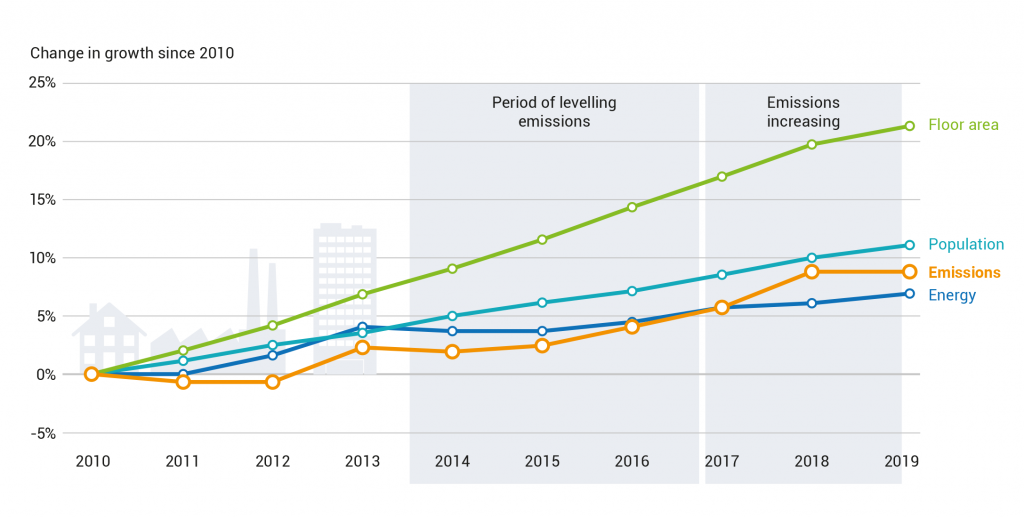
However, pandemic recovery packages provide an opportunity to push deep building renovation and performance standards for newly constructed buildings, and rapidly cut emissions. The forthcoming updating of climate pledges under the Paris Agreement – known as nationally determined contributions or NDCs – also offer an opportunity to sharpen existing measures and include new commitments on the buildings and construction sector.
Energy-efficient building investment rising
In 2019, spending on energy-efficient buildings increased for the first time in three years, with building energy efficiency across global markets increasing to USD 152 billion in 2019, 3 per cent more than the previous year. This is only a small proportion of the USD 5.8 trillion spent in total in the building and construction sector, but there are positive signs across the investment sector that building decarbonization and energy efficiency are taking hold in investment strategies.
For example, of the 1,005 real estate companies, developers, REITS, and funds representing more than USD 4.1 trillion in assets under management that reported to The Global ESG Benchmark for Real Assets in 2019, 90 per cent aligned their projects with green building rating standards for construction and operations. Green buildings represent one of the biggest global investment opportunities of the next decade, estimated by the IFC to be USD 24.7 trillion by 2030.
Further recommendations
Aside from calling for a green recover post-pandemic and updated NDCs, the report also recommends that owners and businesses should use science-based targets to guide actions and engage with stakeholders across the building design, construction, operation and users to develop partnerships and build capacity.
Investors should reevaluate all real estate investment through an energy-efficiency and carbon reduction lens. Other actors across the value chain should adopt circular economy concepts to reduce the demand for construction materials and lower embodied carbon and adopting nature-based solutions that enhance building resilience.